




As an international multidisciplinary research and teaching centre and a centre of excellence in terms of human and technical resources, CEREGE covers almost the entire field of environmental geosciences.
By joining forces with other major national and international research structures and with industrial and technological players, CEREGE is now a centre of excellence in the field of geosciences.
CEREGE provides the academic and industrial scientific community with a range of high-tech resources.
CEREGE's teaching covers the entire spectrum of training in Earth and environmental sciences, from undergraduate to doctoral level.
Through the dissemination of its scientific communication, CEREGE aims to establish a permanent dialogue between science, research and the general public, especially the younger generation.
CEREGE covers the disciplines of Environmental Geosciences (palaeoclimatology, palaeoceanography, geodynamics, soil dynamics, water, waste, planetology....).
We store «wet» elements (water, sediment, etc.) in containers and cold rooms, while «dry» storage is kept in carousels and laboratories.
The geographical spread, combined with the variety of typologies and the ever-increasing number of samples, made it necessary toé not only the involvement of staff but also the implementation of a database managed by an integrated management system called collec-science.
The team
You can reach us at this address: stockage@cerege.fr
The need to coordinate the management of samples in order to share information, track exchanges, analyses and data so that they can be re-used, ensure data traceability, provide access to sites that are currently inaccessible, and provide access to data and associated publications led to the creation in 2019 of the Cellule de Conservation des Collections Scientifiques (C3S) (Scientific Collections Conservation Unit), which has taken up these issues in a national context concerning the preservation of collections (Paléonto symposium, Villers sur Mer, Sept. 2022; geocollections and Virtual Geotheque network).
It is organised around a project team of 3 people, technical advisors from the 4 teams, scientific resource people in the teams and is linked to the Management via 2 advisors.
There are 2 closely related issues at stake:
Structural issues to ensure that samples are properly stored and that there is room for everyone.
Preservation issues information and guaranteed visibility
Constructing, storing, organising and presenting data in such a way as to make it easily and quickly accessible and reusable.
How do we do it?
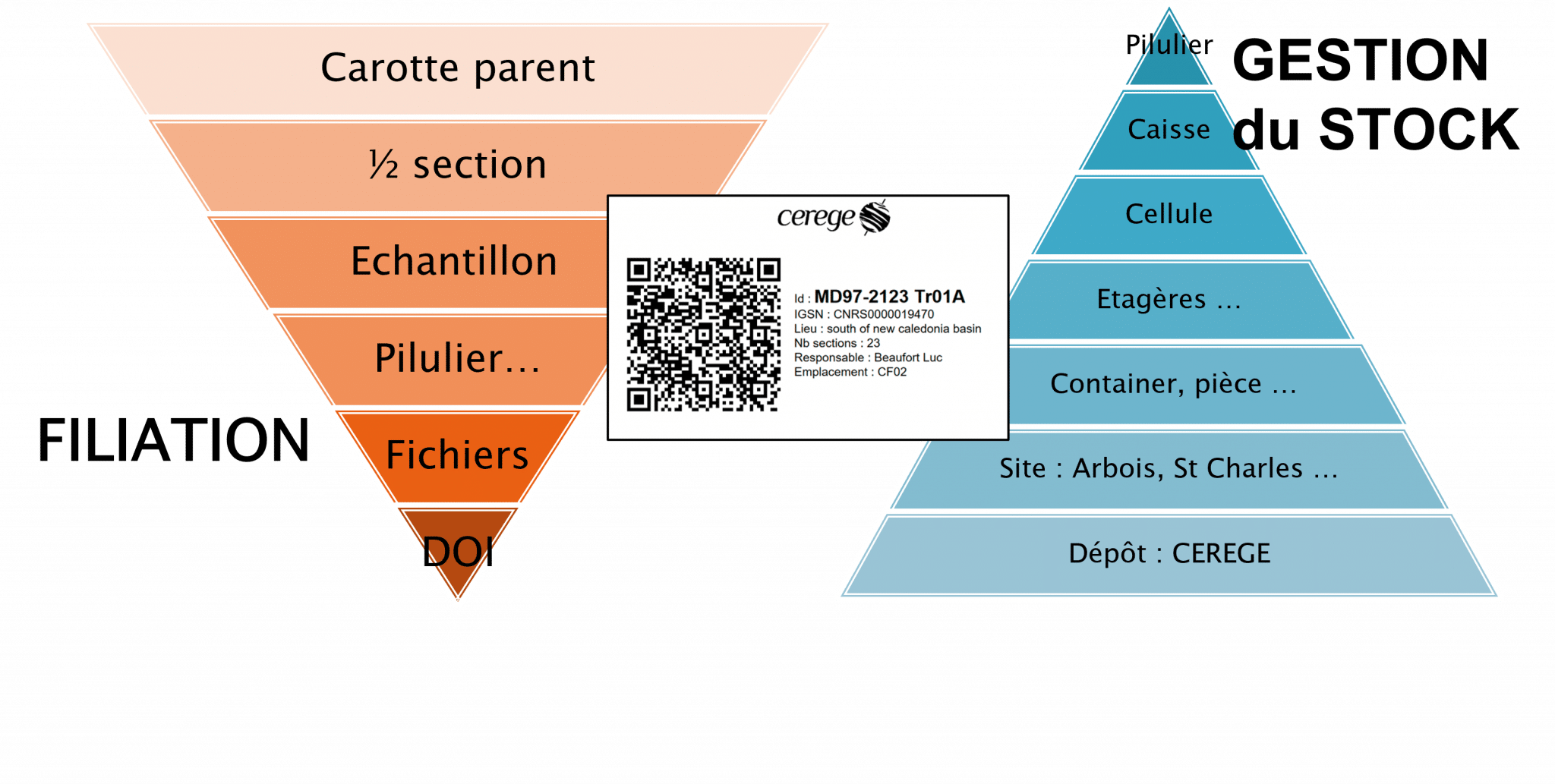
A relational database with nesting :
C3S is proposing its own ontology and thesaurus in consultation with researchers and the community that has carried out this work (CyberCarothèque WG, IGSN, eRecolnat).
Today, is a CEREGE collection created for 6 types of sample (sediment, rock, soil, biology, liquid, ice), 19 types of container and a metadata template specific to the Geosciences.
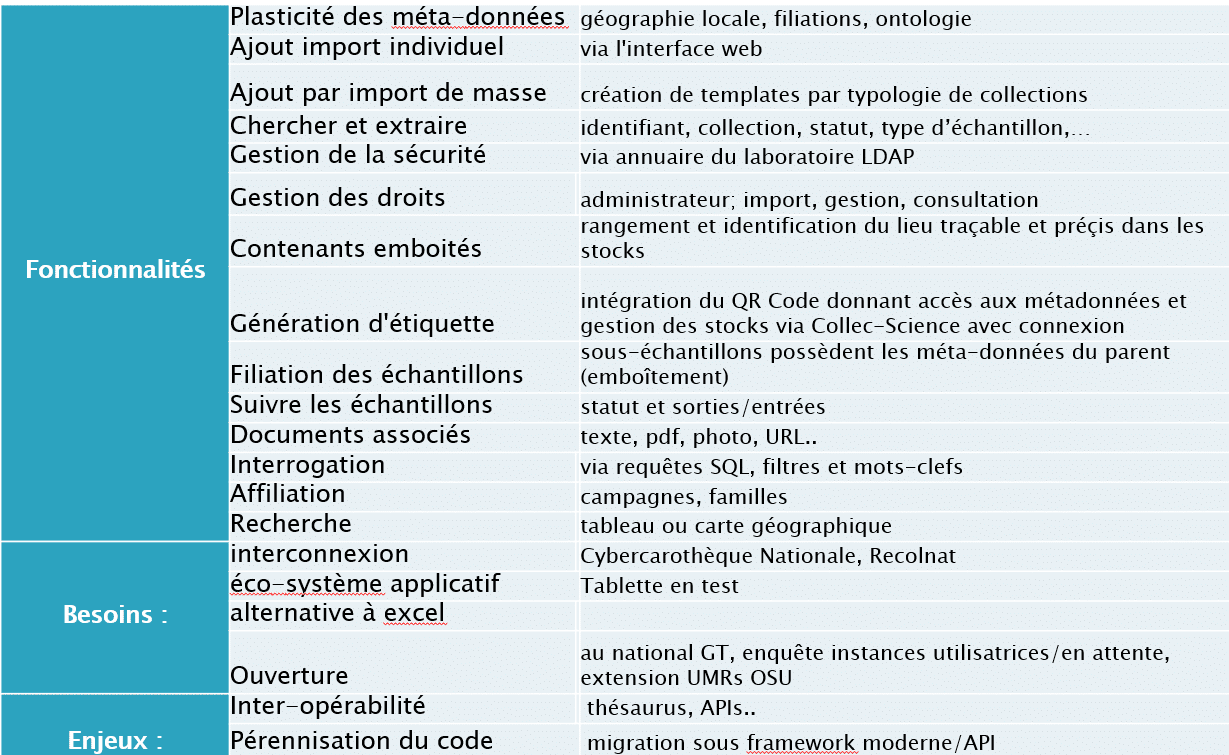
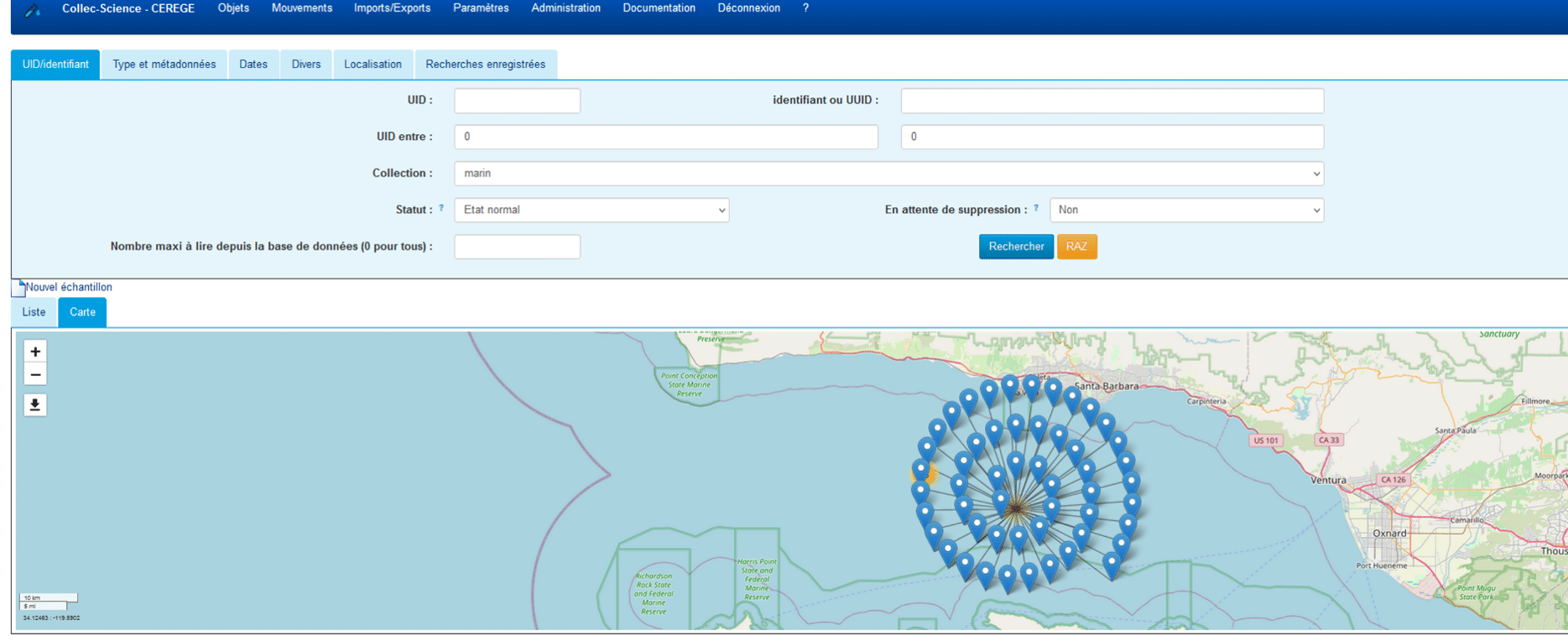
Collec-Science (CS) is a modular web application, A customisable system for tracking samples collected as part of scientific experiments.
We have adapted CS to our data structure in order to :
Today, this work is part of an ongoing national reflection with participation in the Collec-Science, COPIL Cybercarothèque, GT Géothèque Virtuelle and GT BDD REGEF working groups.
The aim is to make the information and associated samples dynamic.