

Originally from south-east France, Florence Sylvestre studied geology at the Muséum national d'Histoire naturelle (MNHN) in Paris. During this time, she met Michel and Simone Servant, two specialists in tropical palaeoclimates* at the IRD (then Orstom). They suggested that the young student fly to Bolivia to study the past hydrological evolution of the Altiplano lakes. They invited her to study diatoms in particular, unicellular microorganisms present in all aquatic environments. These algae are excellent bioindicators**, providing information about water quality and the evolution of the aquatic environments in which they develop.
Diatom passion

For several months, the doctoral student worked on sedimentary archives taken from lakes on this plateau located at an altitude of over 3,600 metres, and in her thesis, for the first time, detailed the hydrological and climatic variations of the Altiplano over the last 15,000 years. Following in the footsteps of her «scientific parents», as she calls them, Florence Sylvestre devoted her career to the study of tropical palaeoclimates and diatoms.
" These microorganisms are fascinating, with beautiful glass skeletons and over 70,000 different species., she stresses. Diatoms are an essential tool for reconstructing past climates and analysing water quality.. "
Brazilian coasts and Argentinian lakes
On her return to France, Florence Sylvestre was appointed lecturer at the University of Angers, aged just 27. For seven years, she continued her work on the Bolivian Altiplano. She extended her research to other environments in Latin America, such as the coasts of Brazil and Guyana and the lakes of Argentina. After spending six months in Canada studying the Arctic environment, at the age of 35 she became director of research at the IRD's European Research and Teaching Centre for Environmental Geosciences (Cereal).
Isotopes and lake systems in Chad
The researcher continued her work on Latin America, but from the end of 2000 she turned her attention to Africa, and in particular Lake Chad. « Everyone was alarmed that it was disappearing at a time when, according to climate change predictions, rainfall was set to increase in the Sahel. So I launched a research project on this lake and its catchment area and coordinated a number of missions, notably to Chad. The results have now been confirmed: Lake Chad is not drying up - quite the contrary! "

Credit: Corinne Sonzogni
On joining Cerege, Florence Sylvestre is contributing to the development of an innovative methodology using the isotopic composition*** of oxygen in diatoms as a tracer of climate parameters. She is incorporating modelling and spatial hydrology approaches to gain a better understanding of lake systems and their hydrological cycles, past and present. The aim is to estimate lake water resources and provide this expertise to local institutions to improve governance. The Chad of the lakes, The book she co-edited, to be published in 2019, is rooted in this vision and offers a multidisciplinary approach to the trajectory of Sahelian wetlands in the face of the challenges posed by global change.
Local partnership
After several long-term assignments, Florence Sylvestre moved to Chad in 2020, where she was assigned to the Geology Department at the University of N'Djamena. As the IRD's representative in Chad, where she is the Institute's only expatriate, she is working hard to set up partnerships and train students who are now teaching and researching at their universities. She also co-directs the LMI VIABELEAUX with Dr Zakinet Dangbet from the University of N'Djamena. «Only Lake Chad was studied, although there are four other large lakes that are important for the country's economic development, explains Florence Sylvestre. Thanks to LMI, Chadian students go out into the field to study these lakes in collaboration with researchers in the humanities, geologists and hydrologists. The aim is to propose an integrated and inclusive approach to land management that is shared by all local stakeholders.. » Finally, she is involved in promoting Chadian women in higher education and research alongside the French embassy.

* climate of a past geological period
** a group of organisms whose presence or state provides information on certain ecological characteristics of an ecosystem.
***Proportions of the various isotopes, or versions, of a chemical element.



Credit: IRD - Edwige Lamy


Articles and books
. Lake Chad is not drying up , IRD le Mag’ 2020
. The gender issue in Chad..., IRD le Mag’ 2022
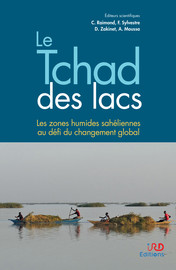 The Chad of the lakes
Sahelian wetlands and the challenge of global change. IRD editions 2019
Christine Raimond, Florence Sylvestre, Dangbet Zakinet and Abderamane Moussa