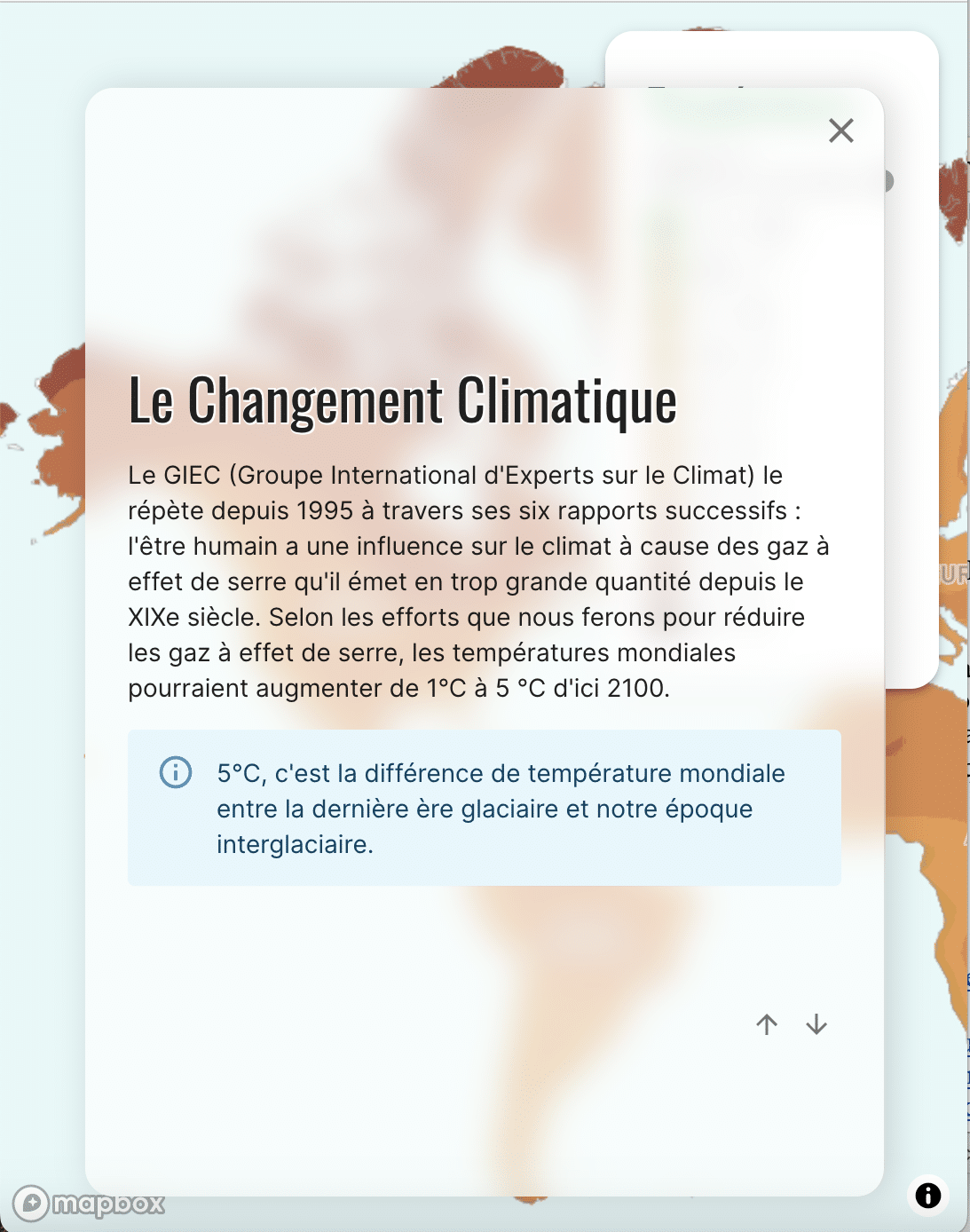
Where will it be possible to grow vines in France in 2080? What will happen to the Svalbard ice cap? Which desert country could be covered in tropical forests by 2100? SimOn, the climate change simulator based on the IPCC's scientific models, will help you find the answers!
Interview by Fanny Trifilieff for Infuse, with Joël Guiot, a palaeoclimatologist at CEREGE, co-president of GREC-Sud, co-coordinator of MedECC and author of the IPCC's special report on +1.5°C warming, who helped to draw up this project.
Article published on 23 November 2023, with the support of’ITEM (Mediterranean Institute for Environmental Transition.)
Infuse: How was SimOn developed?
Joël Guiot : SimOn (Simulator On) has been developed by the Cité de l'Environnement association, This 1901 association was set up by two brothers, Hadrien and Clément Levard, to develop fun tools to raise public awareness of environmental issues. These can take the form of games, digital tools, exhibitions or professional training materials.
The development of SimOn was based on the observation that there was no easy-to-use, multi-scale (from the PACA region to global scale, for example) and multi-parameter (biomes, temperatures, precipitation, rising sea levels) tool for simulating climate change based on the various scenarios of the Intergovernmental Panel on Climate Change (IPCC).
This global warming simulation tool is the fruit of collaboration within a multidisciplinary team of people committed to the fight against climate change. These include Corentin Leroux, whose interdisciplinary background helped him to transform and generate the data needed for the fine-scale maps; Macha Bellinghery, a scientific mediator, who made the various functions and the complexity of the model accessible to everyone; and Patrick Browne, a volunteer with the association, who was responsible for the technical development of the current version to provide a fluid and intuitive user experience. The entire management team of the Cité de l'Environnement association, Mathilde Mercier, as well as Hadrien and Clément Levard, also contributed. Finally, I played a part myself by extracting the data from the IPCC climate simulations and supervising the development of the statistical calculations.
This project was carried out thanks to the support of the A*Midex university foundation, initially via the Labex OT-Med, then completed as part of the ITEM, the Mediterranean Institute for Environmental Transition.
Infuse: How does it work?
J.G : The basic data is publicly available. We have extracted them from the CMIP database, which is used to produce the IPCC projections. These projections are based on around twenty global climate models. We have standardised the data and adjusted the spatial scale to produce global average maps. We have also calculated high-resolution maps that focus on France and the Provence-Alpes-Côte d'Azur region.
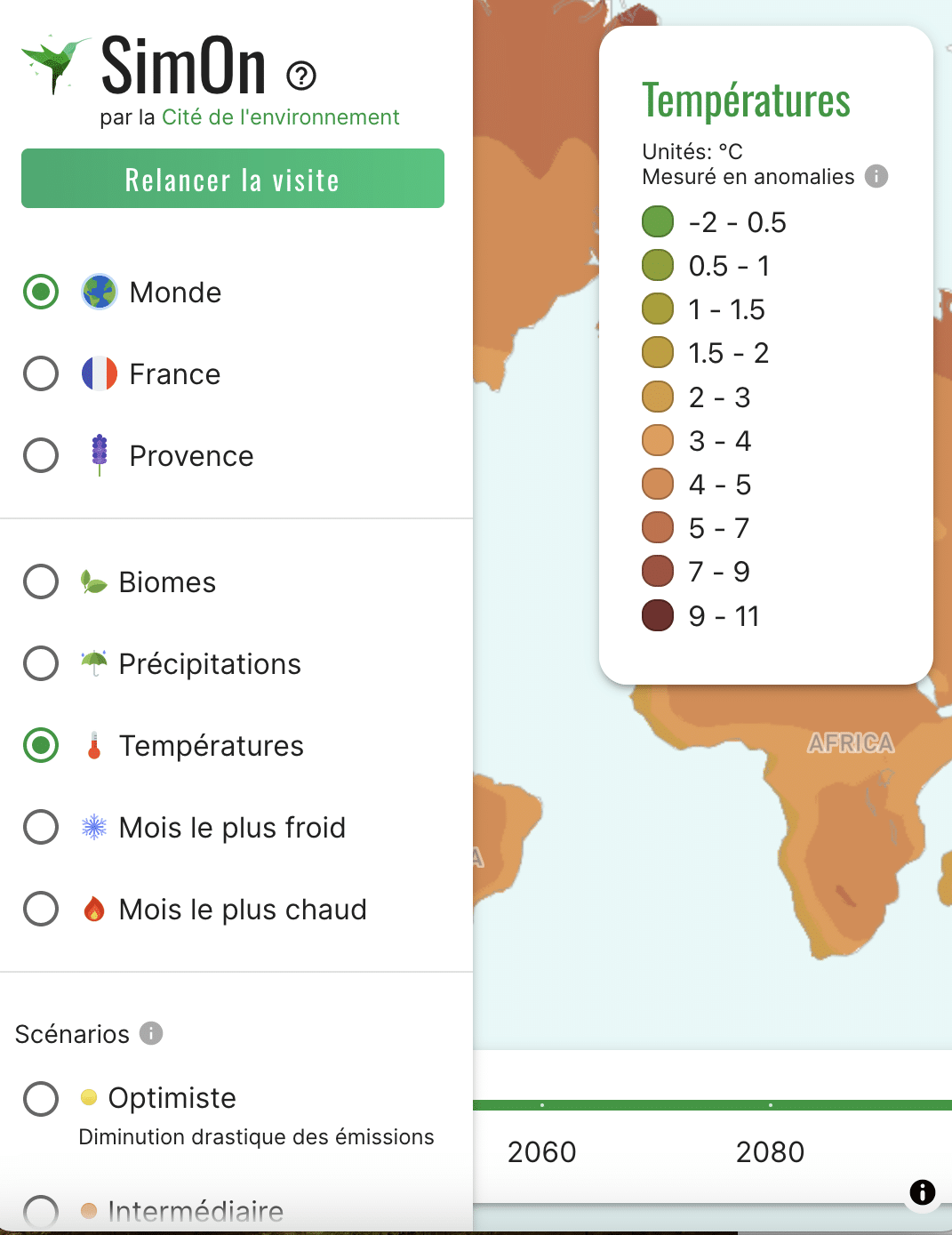
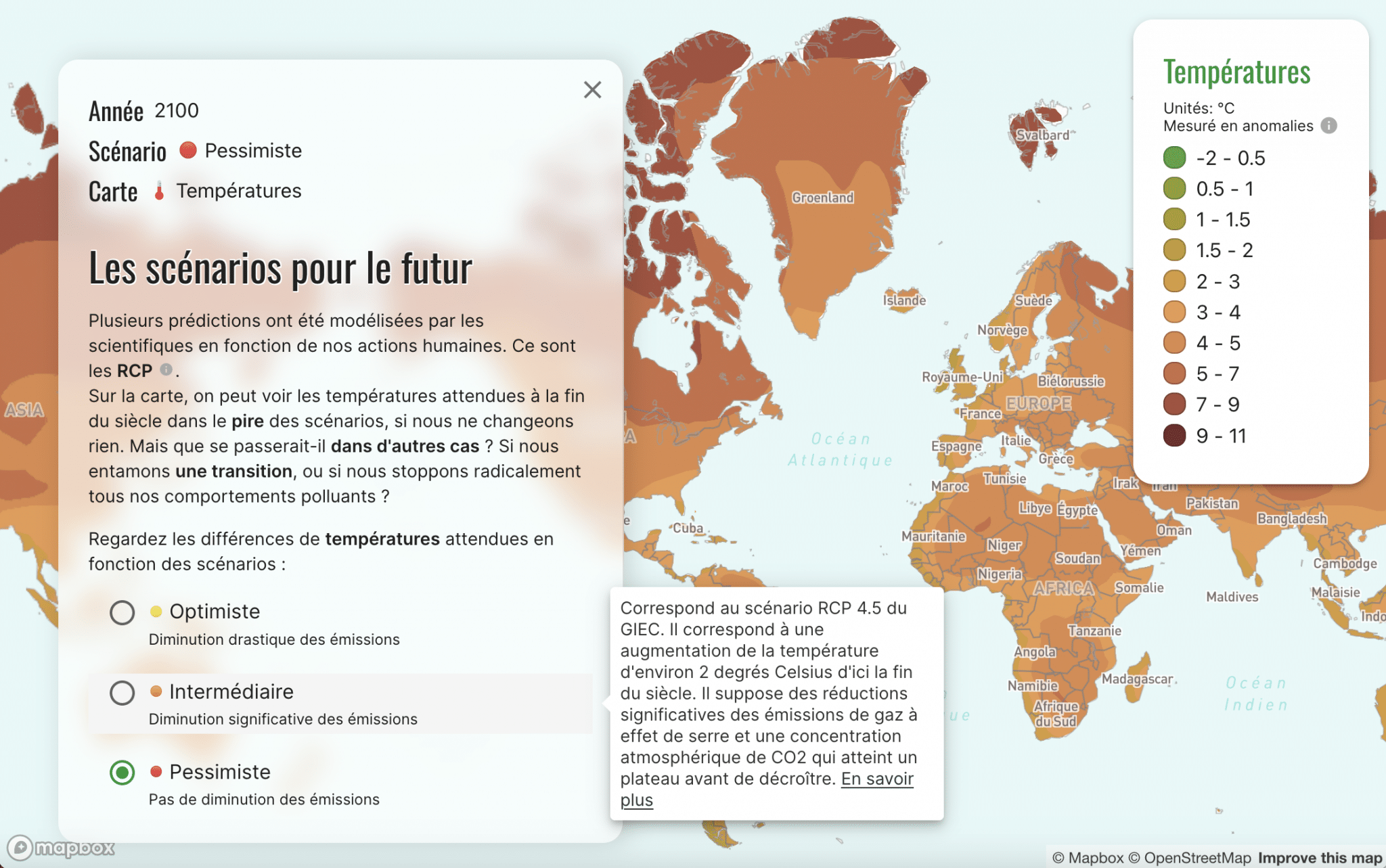
When the application is opened, a short tutorial explains how to vary the climate variables, the scenarios and the time horizon. The scenarios proposed correspond to IPCC forecast scenarios. There are three of them:
- The first, known as the “optimistic scenario”, is the one that moderates greenhouse gas emissions in line with the Paris Agreement.
- The second, the “intermediate scenario”, does not respect the Agreement and is the one we are currently following.
- The third “pessimistic scenario” is the one where no effort is made, also known as «Business as usual».
The time horizon varies linearly from 2020 to 2100 using a manual cursor or an automatic animation. The user can start from the world map and focus successively on France, then on the PACA region. The areas that could be flooded as a result of rising sea levels are also projected onto the PACA region. This rise is progressive depending on the scenario chosen, from 40 cm to 90 cm in 2100. We also provide the distribution of vegetation (the major biomes) according to the corresponding climate. For example, Mediterranean vegetation can be seen moving northwards in France as the climate warms.
Infuse: What are the aims of such a project?
J.G The free tool is aimed at anyone seeking a better understanding of the issues surrounding global warming, and we hope that it will help to raise awareness among as many people as possible, especially schoolchildren and students. It will also be made available as part of the Odysseo project for the future Environment Museum currently being developed in Marseille.
This tool is in no way intended for scientific research. Its sole purpose is educational. We hope that it will help people to understand the global and local issues surrounding climate change and motivate them to change their lifestyles to prevent our environment from becoming unliveable.
Discover the simulator
Glossary :